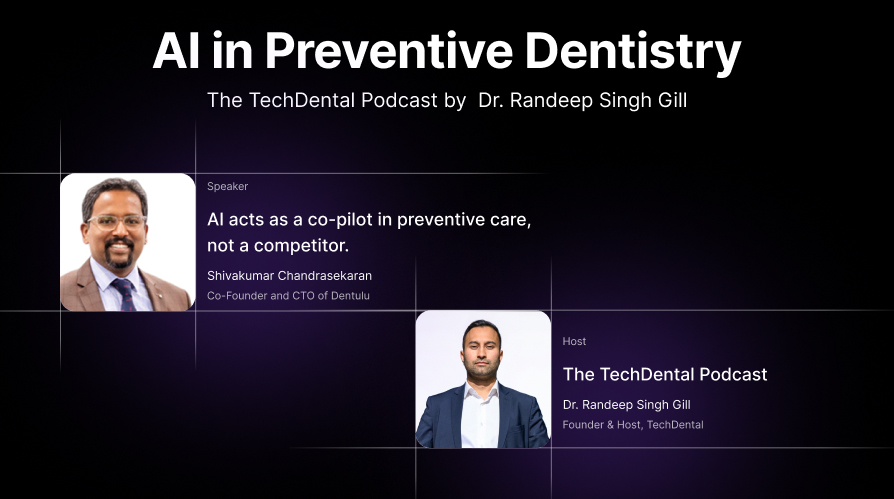
For over a century, the dental profession has operated under a “break-fix” model. Patients generally visit a dentist when they experience pain, and clinicians spend the majority of their time performing “surgical” interventions drilling, filling, and extracting. However, a profound shift is underway. As Shivakumar Chandrasekaran, Co-Founder and CTO of Dentulu, discussed in a recent episode of The TechDental Podcast, we are entering the era of Dentistry 3.0.
In this new landscape, Artificial Intelligence (AI) and telehealth are not just buzzwords; they are the “co-pilots” that allow dentists to transition from reactive repairmen to proactive health guardians.
The Problem: The High Cost of Being Reactive
The traditional dental workflow is often inefficient for both the provider and the patient. In a reactive system, by the time a problem is diagnosed, it is usually expensive, invasive, and painful. Furthermore, dentists are facing unprecedented levels of burnout. The administrative burden of documenting cases, explaining treatment plans to skeptical patients, and managing a physical office can overshadow the clinical “art” of dentistry.
Shiva points out that the solution isn’t just “working harder” it’s working smarter through a digital ecosystem that prioritizes preventive care.
The most significant breakthrough discussed is the role of AI-powered diagnostics. Many practitioners worry that AI aims to replace the dentist’s clinical judgment. Shiva argues the opposite: AI is a tool that enhances the dentist’s reach and accuracy.
Accuracy and Objective Truth
Human eyes are subject to fatigue and “confirmation bias.” AI, however, can analyze thousands of radiographs with over 90% accuracy, flagging the tiniest shadows of interproximal decay or early signs of bone loss that might be overlooked during a busy afternoon. This provides an objective “second opinion” that validates the dentist’s findings.
Building Patient Trust
One of the greatest barriers to treatment acceptance is a lack of trust. When a dentist says, “You have a cavity,” the patient may be skeptical. When an AI algorithm highlights that same cavity in bright red on a screen, the diagnosis becomes an objective fact. This transparency shifts the dynamic from a “sales pitch” to an educational moment.
Prevention is impossible if the dentist only sees the patient once every six months. To truly prevent disease, monitoring must happen where life happens: at home.
The MouthCAM, Dentulu’s signature intraoral camera, acts as the “front door” to the digital practice. By allowing patients to take high-definition photos and videos of their own mouths, the platform enables:
Perhaps the most “future-proof” insight Shiva shared is the growing importance of salivary testing. For years, the dental and medical fields have been siloed. However, the mouth is the “gateway” to the body.
Modern salivary tests can identify specific pathogens linked to systemic issues:
By integrating salivary diagnostics into the preventive workflow, dentists become essential partners in a patient’s overall healthcare team, detecting risks for heart disease long before a patient might visit a cardiologist.
A common critique of new technology is that it adds more work to a clinician’s already full plate. Shiva addresses this by highlighting how Dentulu’s ecosystem is built for workflow integration.
Is preventive dentistry profitable? Shiva answers with a resounding “Yes.” While a filling might be a one-time fee, a preventive-focused practice builds a loyal, long-term patient base.
Patients today, especially younger generations, value convenience and transparency. They are looking for providers who offer telehealth, app-based communication, and proactive health monitoring. Practices that embrace these tools “future-proof” themselves against a shifting market where patients are increasingly taking charge of their own health data.
Conclusion: Preserving the Human Touch
The most poignant part of Shiva’s talk is the reminder that technology is a tool, not a replacement. By delegating the repetitive tasks like analyzing thousands of pixels in an X-ray or tracking hygiene appointments to AI and digital platforms, the dentist is freed to do what they do best: provide empathetic, human-centric care.
The future of dentistry isn’t just about better drills; it’s about a smarter ecosystem where the patient is empowered, the dentist is supported by an AI “co-pilot,” and prevention is the foundation of every smile.
Listen to the podcast below:
https://podcasts.fame.so/e/lnqwlmwn-why-ai-is-a-co-pilot-not-a-competitor-in-preventive-care

 Patient Subscription
 Dental Professionals
 Vendors