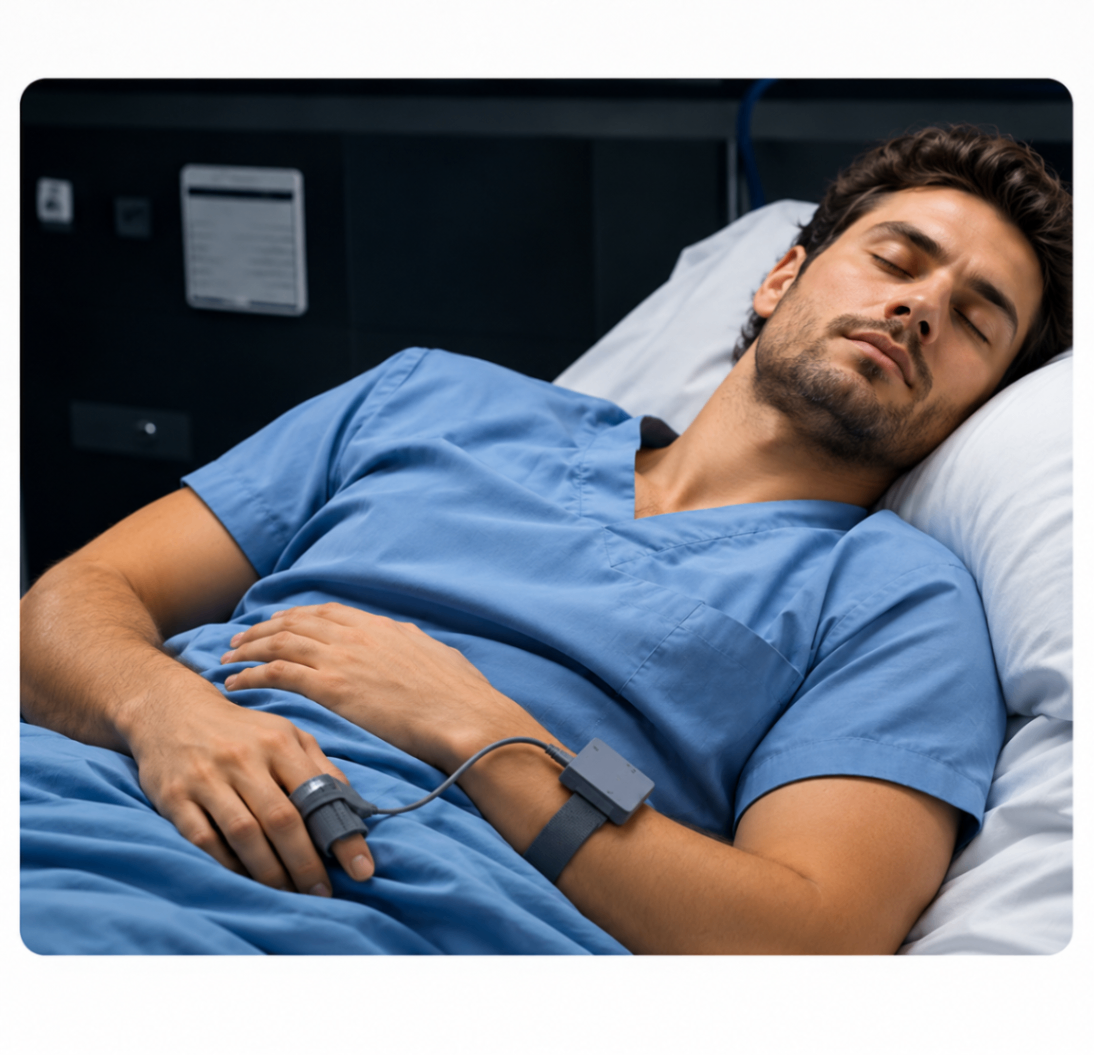
If you snore loudly, wake with a headache, or feel tired even after a full night in bed, it’s natural to wonder whether you need a sleep apnea test. Symptoms can be a reason to talk with a healthcare professional, but they don’t confirm a diagnosis on their own. At Dentulu, the starting point is a virtual consultation, and if testing is appropriate you can take an at-home sleep study without an overnight clinic visit.
The next step is a clinical evaluation. It helps determine whether you need testing and, if so, whether a home sleep test or an in-lab study is the better fit. The American Academy of Sleep Medicine (AASM) recommends testing as part of a comprehensive sleep evaluation.
Sleep apnea can cause breathing to repeatedly start and stop during sleep. Signs may be noticed by you or by someone who shares your room. The National Heart, Lung, and Blood Institute (NHLBI) lists symptoms that include:
You don’t need to have every symptom to ask about an evaluation. If a partner notices pauses in your breathing, or you regularly wake unrefreshed and feel sleepy during the day, share those details with a healthcare provider. The NHLBI advises discussing symptoms with your provider, who can determine whether you may need a sleep study.
A test may be appropriate when your symptoms and medical history raise concern for obstructive sleep apnea (OSA), a form of sleep apnea involving repeated blockage of airflow during sleep. AASM says a home sleep apnea test or an in-lab study may be used for uncomplicated adults with symptoms indicating increased risk of moderate to severe OSA. Read the AASM diagnostic testing guideline.
As one guideline example, increased risk includes excessive daytime sleepiness along with at least two of the following: habitual loud snoring, someone witnessing you stop breathing or gasp or choke in your sleep, or diagnosed high blood pressure. This is a guide for clinicians, not a self-diagnosis checklist.
A questionnaire or online screening result can help start a conversation, but it cannot diagnose OSA by itself. AASM recommends diagnosis using a sleep study rather than a questionnaire alone.

Both options measure sleep-related breathing, but they’re not interchangeable in every situation. Your healthcare provider should help choose the test based on your symptoms, health history, and the kind of information needed.
| Home sleep apnea test | In-lab sleep study | |
|---|---|---|
| Where it happens | At home, using a portable device | Overnight at a sleep center |
| What it involves | Typically fewer sensors than a lab study | Sensors monitor brain waves, breathing, heart rate, oxygen, and other signals |
| May be considered for | Some adults with suspected OSA and no complicating health concerns | People who need a more detailed assessment or have certain health conditions |
| Important limit | May not provide enough information to rule out OSA in all cases | Can provide more detailed measurements and help assess other sleep disorders |
The NHLBI explains that a sleep-center study can record brain waves, heart rate, breathing, oxygen levels, and muscle movements. A home test uses a portable device, and what it records varies by device.
AASM recommends polysomnography, the medical term for an in-lab sleep study, rather than home testing for adults with certain conditions or circumstances, including significant heart or lung disease, a history of stroke, chronic opioid use, severe insomnia, or suspected sleep-related hypoventilation. A clinician can help decide what applies to you. See the AASM guideline.
Home testing is also not a universal choice for children or for people who may have another sleep disorder. Ask your healthcare provider which type of assessment is appropriate rather than assuming an adult home test will answer every question.
A negative result may feel reassuring, but it does not always settle the question. If your test is negative, unclear, or doesn’t capture enough usable data, and your symptoms still raise concern, AASM recommends an in-lab sleep study for diagnosis. A home test can be a useful starting point for eligible adults, but it is not the right final answer in every case.
That’s why it matters to review the result with a healthcare professional. If you still feel unrefreshed, have witnessed breathing pauses, or struggle with sleepiness, ask what follow-up makes sense.
The exact steps depend on the device and the clinician arranging your test. Generally, you use a portable monitor during sleep, return or transmit the recorded data as instructed, and have a qualified clinician review the results. A home test is not the same as a sleep diary, a wearable’s sleep estimate, or an online risk score. The NHLBI describes how providers decide whether testing should take place at home or in a sleep center.
Dentulu uses an FDA-cleared device worn around the finger while you sleep, returned in a prepaid envelope, with the recording reviewed by a licensed physician. The test is $249, reduced from $299, and a $250 deposit is held while the device is on loan and released once it comes back in the prepaid envelope. Your device comes with its own wear instructions, and your care team can tell you how many nights of usable data your test needs. A home test is not appropriate for everyone, and a physician may recommend an in-lab study or follow-up testing.

A few simple notes can help you explain what’s happening. Before you speak with a provider:
The NHLBI suggests keeping a sleep diary with notes about sleep times, awakenings, and how rested or sleepy you feel. It can help you describe your experience, but it does not replace a sleep test when one is needed.
If you’re so sleepy that driving may be unsafe, don’t drive. Arrange another way to get where you need to go and contact a healthcare professional about the sleepiness. For severe difficulty breathing while awake, seek emergency medical help. The NHS provides guidance on symptoms that need urgent or emergency attention.
No. Snoring is one possible sign, but it does not confirm OSA. A healthcare professional can review your symptoms and decide whether testing is appropriate. AASM guidance.
A screening tool can help flag a reason to seek advice, but it cannot diagnose OSA. Diagnosis requires an appropriate sleep test interpreted in the context of a clinical evaluation. AASM diagnostic testing guideline.
No. AASM recommends in-lab testing for some people with particular medical conditions or sleep concerns. Your provider can help select the test that fits your health history and symptoms.
Contact the clinician who arranged the test and explain that your symptoms continue. AASM recommends an in-lab study when a home test is negative, inconclusive, or technically inadequate and OSA still needs to be assessed.
You don’t have to decide alone whether a home sleep test is enough. Track what you’re experiencing, share it with a healthcare professional, and ask which test, if any, makes sense for you. A clear evaluation can help you understand your options and what to do next.

 Patient Subscription
 Dental Professionals
 Vendors