Saliva does more than keep your mouth healthy. It carries a running record of what’s happening in your mouth and increasingly, dentists are learning to read it. Salivary testing is the practice of collecting a saliva sample and analyzing it for specific bacteria, viruses, fungi, or inflammatory markers that can inform a dentist’s understanding of a patient’s oral health. The value of a test depends on exactly what it is designed to measure.
The idea is appealing for an obvious reason: a saliva sample is painless to collect, doesn’t require a needle or a biopsy, and can be done in minutes. But it’s worth being precise about what these tests can and can’t do today, because the marketing around salivary diagnostics has sometimes moved faster than the evidence.
The clearest, best-supported use of salivary testing is detecting the presence of specific microorganisms. Modern lab panels can identify:
Periodontal bacteria : Pathogens associated with gum disease and its progression.
Cavity-causing bacteria: Organisms such as Streptococcus mutans and Lactobacillus, which are linked to a higher risk of tooth decay.
HPV strains and Candida species: Relevant to oral health monitoring in specific clinical situations.
Select inflammatory markers such as IL-6, which can reflect a heightened inflammatory response.
Detecting these organisms or markers doesn’t diagnose a disease on its own, it gives a dentist one more data point to weigh alongside a clinical exam, X-rays, and patient history. That’s an important distinction, and it’s the honest way to describe what these tests are for.
No single saliva test provides a complete picture of oral or general health. Testing also cannot replace professional evaluation when symptoms require examination. Tooth pain, swelling, bleeding gums, persistent bad breath or other concerning symptoms should be assessed by a dental professional.
The American Dental Association’s (ADA) own guidance is worth quoting directly here. As of the ADA’s most recent review, there are no FDA-approved salivary diagnostic tests specifically for evaluating periodontal disease risk or caries risk – the research is described as promising but still preliminary, and standardization of collection and interpretation is still developing.
Oral cancer detection is the area to be most careful about. The ADA’s living clinical guideline, updated in April 2026, recommends against relying on commercial salivary or other adjunctive tests to decide whether a lesion needs a biopsy, and states that a clinical exam followed by biopsy and histopathological assessment remains the standard for diagnosis. If you or a patient are ever concerned about a persistent sore or lesion, that concern belongs in front of a dentist for an exam, not resolved by a mail-in test.
For patients or practices considering it, the OralDNA process Dentulu offers access to is straightforward:
Order a kit online; it ships within 24 hours.
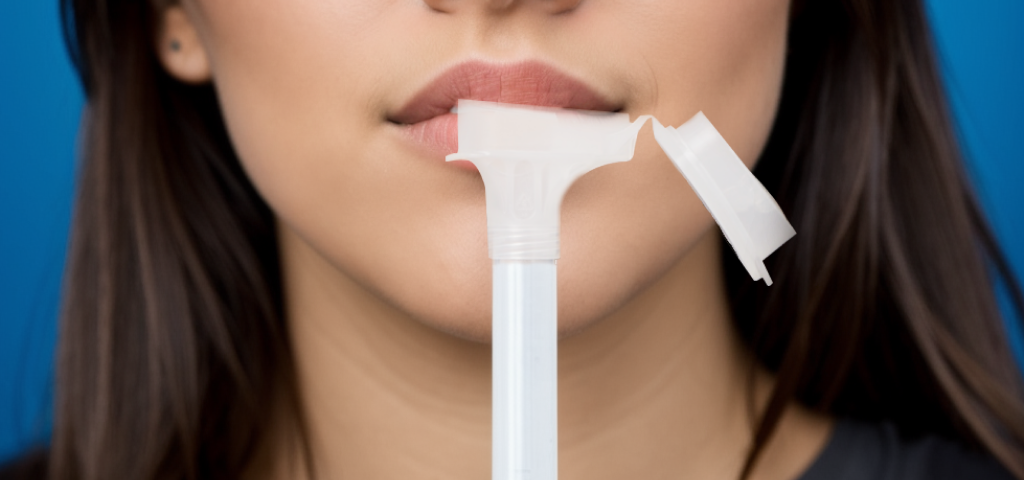
At home, rinse with saline for 30 seconds and deposit a saliva sample into a sterile tube, no fasting required, and the whole thing takes under five minutes.
Return the sample using the prepaid, trackable mailer included with the kit.
Results are available in 7–10 business days through a secure online portal, for review with a dental professional.
A dental examination allows a clinician to directly evaluate teeth, gums and other structures in the mouth. Saliva testing provides information from a biological sample. For that reason, saliva testing should generally be viewed as a complement to clinical evaluation.
Salivary testing works best as a supplement to regular dental care, not a replacement for it. If you’re already seeing a dentist regularly, a test like this can add detail to that relationship flagging a bacterial load worth discussing, or giving your dentist another data point when deciding how aggressively to treat early gum inflammation. Dentulu’s platform is built around exactly that kind of coordination: connecting the testing, the results, and a licensed dental professional who can put those results in context, whether that conversation happens in person or through a virtual consultation.
If something in your mouth is bothering you right now, pain, a sore that isn’t healing, or a change you’ve noticed, the right first step is still a clinical exam, not a test kit.

 Patient Subscription
 Dental Professionals
 Vendors