Understanding what’s happening inside your mouth isn’t always easy. Many oral health concerns are difficult to describe, especially when they’re located in hard-to-see areas like the back teeth or along the gumline. The MouthCAM intraoral camera helps bridge that gap by allowing patients to capture clear images of their oral cavity from the comfort of home and share them with dental professionals for review.
As part of digital oral care experiences offered through platforms like Dentulu, MouthCAM support better communication, visual clarity, and more informed dental conversations without replacing professional dental care.
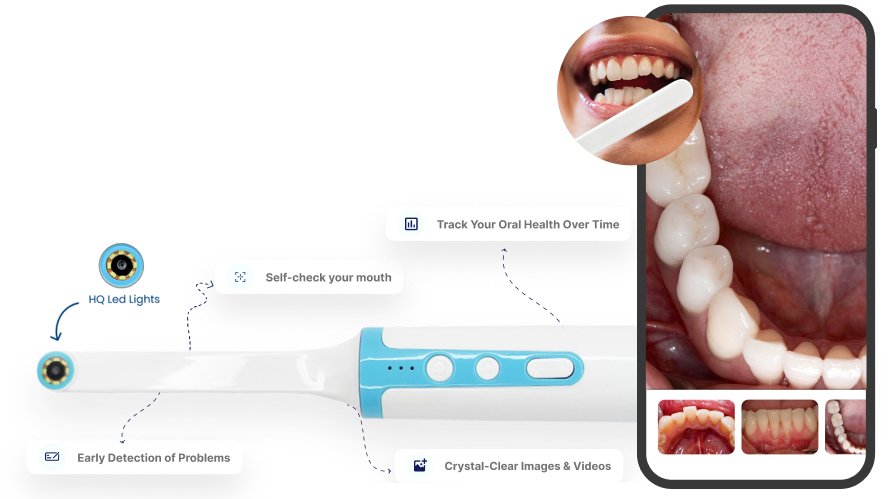
A MouthCAM intraoral camera is a small, handheld dental imaging device designed for personal use. It connects to a smartphone or compatible digital platform that allows users to capture detailed images of teeth, gums, and other visible areas inside the mouth.
Unlike traditional dental cameras used in clinics, MouthCAM is designed for ease of use at home. Patients can take images on their own or with help from a caregiver and securely share them with a dental provider when needed.
The camera serves as a visual support tool, helping patients show what they are experiencing rather than relying only on verbal descriptions.
To suit different patient preferences and use cases, MouthCAM is available in two formats: wired and wireless. Both options are designed to support at-home dental imaging and digital communication.
A wired intraoral camera connects directly to a smartphone or compatible device using a physical cable. This option may appeal to patients who prefer a direct connection without relying on battery charging.
Common characteristics include:
Wired cameras can be helpful for patients who want a straightforward imaging option during scheduled virtual dental consultations.
A wireless intraoral camera connects without a physical cable, offering greater flexibility and ease of movement during image capture.
Wireless cameras may be preferred by patients who value:
Both wired and wireless options are designed to support image capture and secure sharing through supported digital platforms. The choice often depends on personal comfort and usage preference.
Many people delay dental visits because of scheduling challenges, travel limitations, or uncertainty about whether a concern requires immediate attention. At-home dental imaging can help patients feel more informed and prepared before reaching out to a dental professional.
Using a professional dental imaging intraoral camera at home may help patients:
By seeing actual images of their mouth, patients can engage more confidently in conversations about next steps with their dentist.
Teledentistry relies on communication and visual context. While it does not replace in-person exams, virtual dental consultations can be useful for initial discussions, follow-ups, and education.
MouthCAM intraoral cameras support these experiences by allowing patients to:
It’s important to understand that images captured using MouthCAM do not diagnose conditions. Instead, they help dental professionals decide whether further evaluation or an in-person visit may be needed.
One of the main reasons MouthCAM is suitable for patients is its simple, user-friendly design. The device is compact and lightweight, making it easier to handle even for individuals without any dental or technical background.
Patient-friendly features include:
These features make MouthCAM accessible for individuals of different ages and comfort levels with technology.
Dental care often involves explaining areas that patients cannot easily view on their own. Intraoral images help make these explanations clearer.
With MouthCAM, patients can:
This visual approach helps patients feel more involved and informed rather than overwhelmed or uncertain.
MouthCAM is commonly used alongside digital dental care platforms, including MouthCAM solutions integrated with teledentistry services. When connected to a secure platform, patients can submit images directly to dental providers for review.
Within digital care experiences, MouthCAM supports:
All image sharing takes place within privacy-conscious workflows designed to protect patient information.
MouthCAM intraoral cameras may be helpful for:
While the device supports awareness and communication, it should always be used as part of professional dental care not as a substitute for clinical evaluation.
It is essential to set clear expectations when using at-home dental imaging tools.
MouthCAM
Any oral health concern should ultimately be reviewed by a licensed dental professional.
As digital dentistry continues to evolve, tools like the MouthCAM intraoral camera help patients feel more connected to their oral health. By enabling professional dental imaging at home, MouthCAM supports clearer communication, better understanding, and more confident dental conversations.
When used responsibly within teledentistry and guided by dental professionals, MouthCAM helps patients take an active role in understanding their oral health one image at a time.

 Patient Subscription
 Dental Professionals
 Vendors