
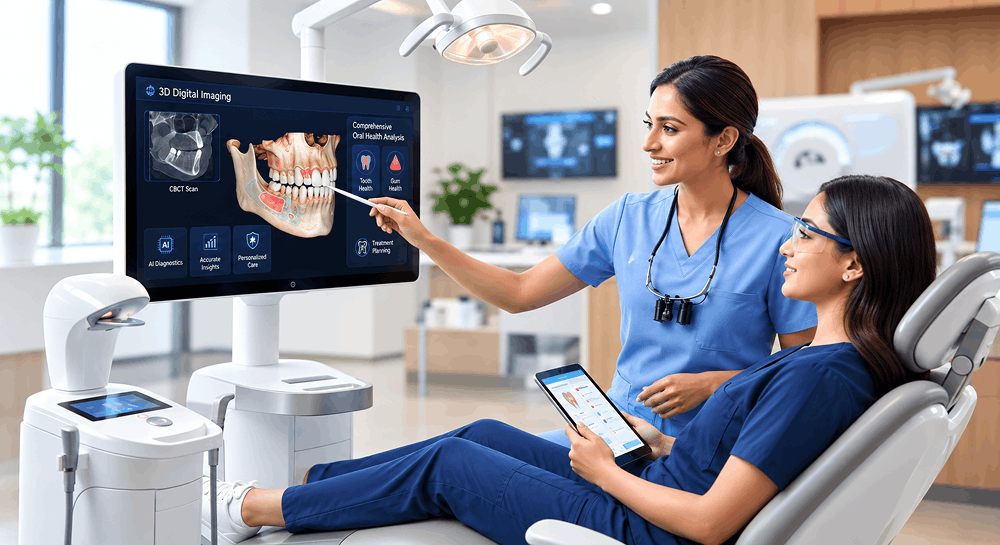
As artificial intelligence transforms global industries, a critical geopolitical debate is taking center stage: Who will control the underlying infrastructure, compute power, and data ecosystems on which the AI economy depends?
This question opened Dialogue I: “Is AI Becoming a Monopoly?” at the AIFOD (AI for Developing Countries Forum) Geneva Summit 2026 at the Palais des Nations in Geneva, Switzerland. Moderated by UNCTAD Legal Officer Kiyoshi Adachi, the panel gathered international enterprise leaders, policymakers, and tech executives to examine whether hyper-concentration in AI accelerates innovation or builds insurmountable barriers for specialized players and developing regions.
Among the featured panel speakers was Shiva Kumar, Co-Founder and Chief Technology Officer at Dentulu. Representing the digital health and teledentistry sector, Kumar provided a stark, field-tested perspective on the real bottleneck in AI adoption, moving the conversation from open-source software to the realities of physical compute infrastructure.
For years, the AI narrative has celebrated the rise of open-source models as an equalizer. The premise was simple: if algorithms and APIs are publicly available, anyone can innovate.
However, during the Geneva Summit panel, Shiva Kumar challenged this assumption. Drawing from Dentulu’s experience deploying AI-driven diagnostic workflows, virtual care systems, and remote patient monitoring across diverse markets, Shiva Kumar pointed out that code accessibility solves only a fraction of the puzzle.
“Open source opened the code, it did not open the infrastructure,” Shiva Kumar argued during the dialogue. “And infrastructure is where the real barrier lives.”
While a developer anywhere in the world can clone an open-source model, executing that model at scale requires expensive compute clusters, high-speed cloud pipelines, low-latency bandwidth, and compliant data hosting systems. When compute resources and cloud backbones remain concentrated within a handful of mega-tech companies, true operational freedom remains out of reach for smaller enterprises, specialized clinics, and developing nations.
The concentration of compute affects who gets to build with AI, not just who gets to use it. A hospital system, a regional dental group, or a research lab in a developing country may have the talent and the data, but without affordable, sovereign access to compute, their ideas stall at the prototype stage. Open weights on a closed platform are a guest pass, not a home.
In healthcare, infrastructure barriers do not just impact software margins; they directly dictate patient access, clinical independence, and data sovereignty.
In oral health and general medicine, AI is moving from a novelty to a fundamental layer of care. Diagnostic tools analyze intraoral imaging, spot early decay, detect airway and sleep issues, and assist clinicians in real-time treatment planning. But when a rural dental clinic or a community health center attempts to run modern diagnostic AI, they face two distinct infrastructure hurdles:
To democratize digital health, healthcare AI must be designed to run effectively on edge devices, local networks, and hybrid frameworks rather than relying solely on centralized infrastructure.
These infrastructure realities are not abstract. They determine whether a patient in a low-connectivity region can receive AI-assisted screening at all, whether their sensitive health images must leave their community to be processed, and whether their local clinic can afford the subscription fees that centralized platforms demand. Infrastructure choices made in distant data centers show up as access gaps in exam rooms.
A key theme throughout the UN Geneva discussion was whether smaller, specialized companies must adapt to the conditions set by big-tech companies, or whether domain-specific platforms can alter the market dynamics.
Dimitri Boylan, Founder & CEO of Avature, noted during the panel that controlling the underlying AI model does not guarantee complete market dominance. The real battleground lies in the software, domain expertise, and integration layers that connect AI to human workflows.
This is precisely where platforms like Dentulu operate. Rather than relying blindly on monolithic cloud providers, vertical health tech companies are building ecosystem-driven approaches:
By focusing on accessible infrastructure, specialized health platforms help prevent healthcare providers from becoming captive consumers of big-tech cloud services. Dentulu applies these same principles in its own AI work, described in our approach to artificial intelligence and in our article on AI as a co-pilot in preventive care.
The debate inside the Palais des Nations concluded with a call to action for governments, health systems, and tech developers: AI governance must focus on infrastructure democratization, local capacity building, and sovereign options.
Public procurement, open health networks, and distributed computing models must be championed so that healthcare innovations benefit all populations, not just those with unrestricted access to hyperscale cloud data centers.
As Dentulu continues to expand its connected care ecosystem across virtual dentistry, chronic care screening, and AI diagnostics, our participation in global forums like AIFOD reinforces a core commitment: AI should empower local clinicians, broaden patient access, and remain decentralized. That commitment also shapes how we deliver care every day, from virtual consultations to at-home diagnostics designed to work where patients actually live.
Read more: Is AI Becoming a Monopoly? AIFOD Opens Geneva Dialogue on Who Controls the AI Economy
AIFOD stands for the AI for Developing Countries Forum, an international initiative that brings governments, businesses, and researchers together to discuss how artificial intelligence can serve developing regions equitably. Its Geneva Summit takes place at the United Nations Palais des Nations.
Because healthcare is one of the sectors where infrastructure concentration has the most direct human consequences. Dentulu’s experience building AI-assisted diagnostic and virtual care tools that must work in real clinics, with real connectivity limits, gives it a practical perspective on what open-source AI does and does not solve.
Edge computing means running AI analysis on local hardware, such as an intraoral camera device or a clinic’s own computers, instead of sending every image to a remote cloud server. This keeps diagnostics fast and available even when internet connectivity is limited, and it helps keep sensitive patient images under local control.
Dentulu designs its AI-assisted tools to work across connected and low-connectivity environments, supports interoperable workflows so clinics are not locked into a single vendor, and keeps licensed dental professionals at the center of every diagnostic decision. AI is used to support care, not to centralize control over it.

 Patient Subscription
 Dental Professionals
 Vendors