Porphyromonas gingivalis and Rheumatoid Arthritis: Microbial Triggers of Autoimmunity
Representative key papers / reviews:
Maresz K, et al. Porphyromonas gingivalis facilitates the development and severity of collagen-induced arthritis (PMC article, 2013).
PubMed/PMC:
https://www.ncbi.nlm.nih.gov/pmc/articles/PMC3771902/
Mikuls TR, et al. Porphyromonas gingivalis and disease-related autoantibodies in individuals at risk of rheumatoid arthritis (2012 / 2014 work). PubMed Links: https://pubmed.ncbi.nlm.nih.gov/22736291/ , https://pubmed.ncbi.nlm.nih.gov/24782175/
Recent reviews/meta-analyses: Summarizing the link between P. gingivalis and RA pathogenesis. PubMed Link: https://pubmed.ncbi.nlm.nih.gov/31268867/
The Oral Microbiome and Rheumatoid Arthritis: Could Gum Bugs Kick-Start Autoimmunity?
Rheumatoid arthritis (RA) is a systemic autoimmune disease characterized by joint inflammation and autoantibodies. Compelling evidence suggests that oral bacteria—especially Porphyromonas gingivalis—may initiate or amplify autoimmune responses through unique biochemical mechanisms, making the mouth a plausible origin point for some RA cases.
Detect high-risk oral pathogens linked to autoimmune risk and coordinate early dental care.
Get Tested Now with Dentulu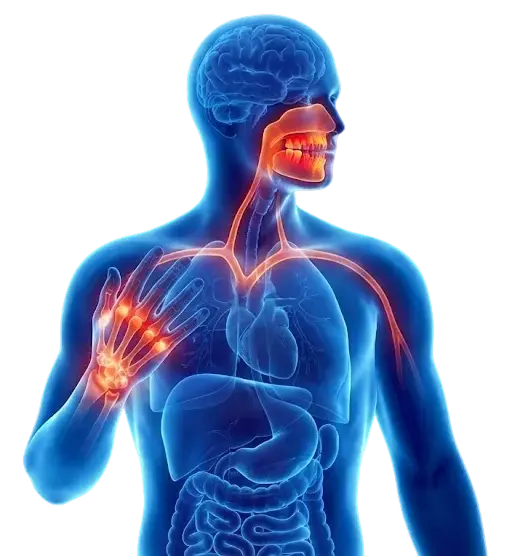
About the Study / Evidence Base
Summary: Multiple human studies, animal experiments, and mechanistic investigations show that P. gingivalis is over-represented in patients with RA and can generate citrullinated proteins via its unique bacterial PAD enzyme (PPAD). These citrullinated proteins are central targets of anti-citrullinated protein antibodies (ACPAs), which are highly specific for RA and appear before clinical disease. Experimental infection with P. gingivalis worsens arthritis in animal models, and serologic evidence links exposure to this bacterium with RA-related autoantibodies.
KEY FINDINGS
- Presence and association: P. gingivalis (or antibodies to it) are more frequently found in patients with RA and in individuals who later develop RA compared with controls.
- Mechanistic enzyme (PPAD): P. gingivalis expresses a bacterial peptidylarginine deiminase (PPAD) that citrullinates host proteins — creating neoantigens that can trigger ACPA formation. This PPAD activity is unique among common human-associated bacteria and is a plausible molecular link to RA autoimmunity.
- Animal models: Oral infection or exposure to wild-type P. gingivalis increases severity and autoantibody production in collagen-induced arthritis models; PPAD-null mutants do not produce the same effect. This supports a causal mechanism in preclinical models.
- Autoantibodies correlation: Studies show correlations between anti-P. gingivalis antibody titers and RA-related autoantibodies (anti-CCP/ACPA), particularly in early RA or at-risk individuals.
- Population-level signal: Meta-analyses and systematic reviews find that exposure to P. gingivalis or periodontitis is associated with increased odds of RA (pooled ORs typically >1.5).
MECHANISM (Mouth → Immune Priming → Joints)
Stepwise mechanistic model linking P. gingivalis to RA
- Local periodontal infection: Chronic periodontitis creates a reservoir of P. gingivalis and high local inflammation.
- Bacterial PPAD activity: P. gingivalis produces PPAD that converts arginine residues on proteins into citrulline (citrullination) in situ, creating novel, immunogenic citrullinated host proteins. This process differs from human PAD and can generate unique neoepitopes.
- Autoantibody formation: The immune system recognizes these citrullinated neoantigens and produces ACPAs (anti-citrullinated protein antibodies), often years before arthritis symptoms. ACPAs are central to RA pathogenesis and predict more severe disease.
- Systemic immune priming & epitope spreading: ACPAs and systemic inflammation can then target joint tissues, leading to synovial inflammation, cartilage damage, and clinical RA. Animal models show this progression after oral infection.
This mouth→immune→joint pathway is a plausible, experimentally supported route linking periodontal infection to autoimmune disease.
Clinical Relevance
Why patients and clinicians should care
- Early RA detection: ACPA-positive RA may begin outside the joint. Detecting oral drivers (like P. gingivalis) could identify people at higher risk before clinical arthritis develops.
- Modifiable risk source: Periodontal disease is treatable. Targeted oral care and eradication of pathogenic reservoirs could reduce antigenic stimulation and systemic inflammation. Evidence on whether periodontal treatment prevents RA incidence is still evolving but biologically plausible.
- Diagnostic synergy: Combining serologic screening for ACPAs with salivary pathogen testing may improve identification of at-risk patients and guide early preventive strategies or referrals to rheumatology.
- Therapeutic implications: If periodontal infection contributes to autoantibody formation, dental infection control could become part of RA risk-reduction strategies in the future—especially for individuals with genetic risk (HLA-DR4) or early autoantibody positivity.
Screen the Mouth Where Autoimmunity May Begin
Identify P. gingivalis and high-risk oral pathogens early—coordinate dental care and rheumatology if needed.
Get Tested Now with DentuluRelated Research
- Periodontitis & ACPA Formation
- Autoimmune Disease & Oral Microbiome
- Salivary Biomarkers for Autoimmune Risk
- Diabetes, Periodontitis & Immune Dysregulation
Have questions? Get answers
References
- Maresz K, et al.: Porphyromonas gingivalis facilitates the development and severity of collagen‑induced arthritis. Arthritis Res Ther. 2013;15:R186. PMC: https://www.ncbi.nlm.nih.gov/pmc/articles/PMC3771902/
- Mikuls TR, et al.: Porphyromonas gingivalis and disease‑related autoantibodies in individuals at risk of rheumatoid arthritis. Arthritis Rheum. 2012. PubMed: https://pubmed.ncbi.nlm.nih.gov/22736291/
- Mikuls TR, et al.: Periodontitis and Porphyromonas gingivalis in patients with established rheumatoid arthritis. Arthritis Rheumatol. 2014. PubMed: https://pubmed.ncbi.nlm.nih.gov/2478275/
- Perricone C, et al.: Porphyromonas gingivalis and rheumatoid arthritis (review). PubMed: https://pubmed.ncbi.nlm.nih.gov/31268867/
- Li Y, et al.: Meta-analysis: P. gingivalis exposure and risk of rheumatoid arthritis. Frontiers in Cellular and Infection Microbiology 2022. https://www.frontiersin.org/journals/cellular-and-infection-microbiology/articles/10.3389/fcimb.2022.956417/full